 Mosquito Spraying
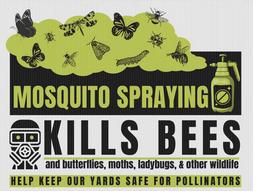
Spraying for mosquitoes can be deadly to our honey bees. A list of hive owner names and addresses was submitted to the Rapid City Parks Department. The Parks Department is mapping these locations and will not spray within 6 blocks of the hive locations. There are many things we can do to prevent mosquito’s from hatching without using pesticides. Here is a link for a ‘greener’ way of controlling mosquitoes.
Arlington Regional Master Naturalists. There is also an excellent resource at the Pollinator Stewardship Council.
Public health officials tend to use an industrial approach to the issue of controlling mosquitos instead of pollinator-friendly vector control. Honeybees (and other pollinators) have no defenses against the application of Permethrin and other related pesticides in the environment. While plant-based repellants also exist, even they have caveats (although with much better results in terms of protecting honeybees if used with care).
The science of mosquito control comes down to a series of considerations and strategies, and while there is no "one size fits all" methodology, there are still general practices that define the process:
Location:
Mosquitos normally lay their egg rafts in fresh or stagnant water sources. These can be as small as a puddle inside a tire all the way up to swampy wetlands. Generally speaking they tend to be active in cool, shady areas with dense vegetation. This includes urban areas like around the foundations of houses and gardens.
Extent:
There are several governmental layers to mosquito abatement. Larger scale operations focus on tracts on land that can be as big as miles-long parcels. For these types of sprays state and county officials often turn to hiring commercial companies that utilize aircraft. These aircraft (usually, but not always helicopters) spray large quantities of pesticides that settle near the ground in fogs and carry with prevailing winds. These operations are usually the worst for pollinators, given the indiscriminate nature of their disbursal.
More localized methods are common to cities and towns that use foggers mounted on truck beds and drive through neighborhoods. Again, this is an airborne spreading technique that is indiscriminate in application, but at least contained to more tightly defined areas. Then there are hand application of pesticides, where workers actually carry backpack-mounted tanks and pedestrian spray. This is usually the smallest means of treating an area, and also the most intricate being able to by-pass specific addresses or areas. This type of spraying has the best potential to avoid spraying near active hives.
Timing:
The general consensus for when to spray is based on when mosquitos are active. This is usually in the early morning and early evening hours when they are on the move. However this is not always the case, and many airborne spray operations can occur in morning or mid-day times depending on winds and takeoff scheduling. However spraying entities can time deployment on honeybee behavior, i.e. around sunset when bees generally return to their hives. Whether or not this is taken into consideration varies with location.
What they spray:
Pesticides commonly used for mosquito control are from a family of synthetic pyrethroids such as Bifenthrin, deltamethrin, sumithrin (d-phenothrin), and permethrin. All of these have been identified as toxic to honeybees when bee contact is made immediately and shortly after spraying. The chemical residue supposedly evaporates in a short period of time thereafter, regardless of how reassurring that may be. Even at a human level, N,N-diethyl-3-methylbenzamide (DEET) is authorized as a topical retail repellant.
Side Effects:
Chemical pesticides have side effects on honeybees. This includes presenting disorientation in their navigation and hive return, stress from elevated levels of toxic exposure, and contamination from pollen producing plants collected and returned to the hive. This in turn contaminates honey, wax, and brood. Chronic exposure to residues weakens their immune systems and can lead to colony collapse.
|