
|
Honeybees are susceptable to a variety of diseases and pests. Knowing what these are and how to treat them is paramount to maintaining the health of your beehives. By being proactive you can identify and mitigate these through regular observation and inspection. Normal healthy hives have three types of bees:
American Foulbrood American Foulbrood is a world-wide honeybee disease caused by the spore-forming bacterium Paenibacillus larvae. It is highly infectious and the most widespread and destructive of bee brood diseases. It is globally distributed and burning of infected colonies is often considered as the only effective measure to prevent spreading of the disease (In the US, many State Apiary Inspectors require an AFB diseased hive to be burned completely. The spores can survive up to 40 years and are difficult to destroy). This disease does not affect adult honey bees, but is highly infectious and deadly to bee broods. When cleaning contaminated cells, bees distribute spores throughout the colony. Disease spreads rapidly throughout the hive as the bees, trying to remove the spore-laden dead larvae, contaminate brood food. Nectar stored in contaminated cells will contain spores and soon the brood chamber becomes filled with contaminated honey. As this honey is moved up into the supers, the entire hive becomes contaminated with spores. European Foulbrood European foulbrood (EFB) is caused by the bacterium Melissococcus plutonius that infects the midgut of bee larvae. European foulbrood is considered less serious than American foulbrood.[28] M. plutonius is not a spore-forming bacterium, but bacterial cells can survive for several months on wax foundation. Symptoms include dead and dying larvae which can appear curled upwards, brown or yellow, melted or deflated with tracheal tubes more apparent, or dried out and rubbery.[29] method Scientific research showed that the spread of the disease is density dependent. The higher the density of apiaries, the higher the probability of disease transmission. European foulbrood is often considered a "stress" disease—dangerous only if the colony is already under stress for other reasons. An otherwise healthy colony can usually survive European foulbrood. Chalkbrood Chalkbrood causes a fungal disease that only affects bee brood, but adult bees can be carriers. It infests the gut of the larvae before the cell is sealed or soon after.[35] The fungus competes with them for food, ultimately causing them to starve. The fungus then goes on to consume the rest of the larval bodies, causing them to appear white, hard, and "chalky". If fungal spores start to develop, the larva can also appear gray or black. One study suggested it could be economically devastating because not only does it weaken the hive, but it can cause honey reductions of 5–37%. Spores of the fungus can last for up to 15 years, which is why old equipment from a previously infected hive should not be used. These spores can last in pollen, honey, and wax. Nosema Nosema apis is a microsporidian, a small, unicellular parasite recently reclassified as a fungus that mainly affects honey bees. It causes nosemosis, also called nosema, which is the most common and widespread of adult honey bee diseases. The dormant stage of N. apis is a long-lived spore which is resistant to temperature extremes and dehydration, and cannot be killed by freezing the contaminated comb. The symptoms of Nosema are relatively nonspecific, which makes it difficult to distinguish from other diseases of the honeybee. It arises mostly in the spring after periods of bad weather, although it may also be a winter disease that is only noticed in the spring when beekeepers first inspect their hives. The female worker bees are most strongly afflicted, less so the drones. The queen bee is rarely infected since afflicted bees rarely participate in feeding the queen. The most notable symptom is dysentery. This appears as yellow stripes on the outside of the hive and in severe cases, inside the hive. Bees may be unable to fly ("crawling") due to disjointed wings. Varroa Mites 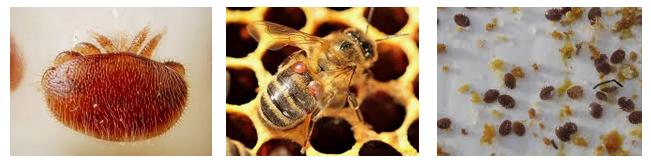 Varroa mites are a global beehive problem and the leading cause of honeybee death. These parasitic mites can only reproduce in honey bee colonies. The males are white, the females are reddish-brown, and they are shaped like a button that allows them to fit under the abdominal segments of bees. They are approximately 1/32" - 1/16" in size. Varroa mites penetrate brood cells to lay their eggs. Their development time is only 6-7 days from egg to adult. Once adults they attach to honeybees to spread. These mites feed on the fat bodies of bees, which are crucial for bee hormones, energy regulation, and detoxification. As the bees weaken they get disoriented and lose weight, shortening their lifespan.
Tracheal Mites 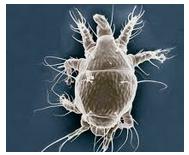 Tracheal mites are tiny internal parasites that require magnification to see. They attach to young bees through their tracheal openings (breathing tubes). Females lay eggs attaching them to the internal tracheal walls, where larvae hatch in 10-15 days. Once mated, they move on to other bees to repeat the process. The mites use their mouthparts to to pierce the tracheal tube walls and feed on the bee haemolymph (similar to blood, the plasma that transports nutrients and oxygen). More than 100 mites can infect a single bee. Because these parasites affect a bee's ability to breathe, they develop an almost total inability to fly, with symptoms commonly finding them outside the hive on the ground. These mites can infect queens, drones, and workers alike.
 Wax Moths  Wax moths, more than hive beetles, are destructive pests and depending on the scenario can obliterate framed comb in hives. They lay their eggs in cracks and spaces in hives (50-100 at a time), vs. in brood like other parasites. Wax moth eggs take between 7-21 days to hatch. When the larvae hatch they feed on the hive comb bodies. This causes particularly bad damage on hives that are inactive and stored away, although active hives are certainly not immune to the destruction these moths cause. The larval stage lasts from 1-6 months, during which time they silk and molt multiple times. Their silk trails can ensnare bees, trapping and killing them.
Small Hive Beetles 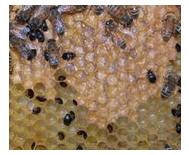 Hive beetles are destructive pests that feed on honey and pollen. They also feed on the bodies of dead bees. They tunnel through comb feeding and defecating, causing the comb to become discolored. Honey infested with small hive beetles can spoil and ferment. The beetles can smell the alarm pheromones released by bees which actually serves as a homing device to bring them into hives. Once established, depending on how extensive their infestation becomes, the bees may actually abandon the hive. Small hive beetles are approximately 1/4" in size. The females lay their eggs in brood, the beetles hatch, and proceed to selectively eat the stored food. These beetles can live months with honey, three weeks on only water and wax, and 10 days with no food or water.
 |
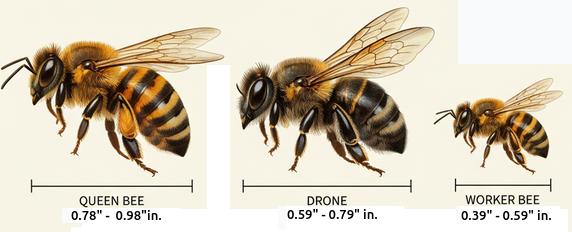 Queen bees are easily identified because they are the largest bee in the colony. She is usually the only adult sexually mature bee present and secretes a powerful pheromone that chemically signals the behavioral and psysiological actions of the hive, and the bees will protect her fiercely. She may have a paint dot on top of her body if she came in a package of bees that were requested with a "marked queen." These colored dots represent the calendar year the queen was born based on the last digit of the year. White year ends with a 1 or 6. Yellowyear ends with 2 or 7, Red year ends with a 3 or 8, Green year ends with a 4 or 9, and Blue year ends with a 5 or 0. Having a healthy queen present and laying brood is the foundation of your hive's success.
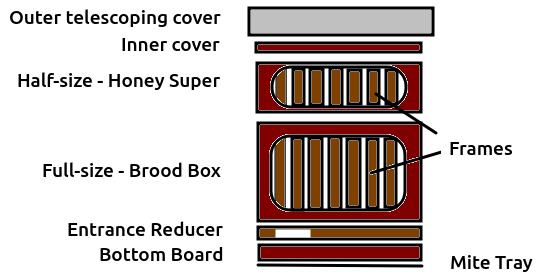 The top cover serves as the "roof" of the hive and functions to regulate temperature and protect from weather. Underneath the top cover is the inner cover. This is a wooden board surrounded by a raised frame. It has an oval hole in the middle, and a small notched opening on the front-facing side. When the top cover is positioned correctly towards the front it allows for ventillation and a secondary entryway for bees to come and go through the inner cover.